The months, as a sequence of decisions
- Set the legal question aside. Known: the state had listed construction as essential and the site could stay open. The question was whether the crews the schedule depended on would actually come, because a legal green light staffs nothing. Asking it moved the planning problem off compliance and onto labor supply, where the job was going to be won or lost.
- Confirm every crew directly, before every phase. Known: the standing subcontractor schedule had been built before the order and was no longer a fact. The question was who would be on site, by name, on the day. So before every phase I called the sub and asked, instead of reading the schedule. Where a sub confirmed, we ran the normal sequence. Where a sub could not, the phase went into the sort.
- Sort the open scope by license against skill. Known: which phases were open and which subs had gone quiet. The question for each phase was what it actually required. Structural framing and the rough trades landed on the licensed side. Finish carpentry, trim, hardware, fixtures and the coordination landed on the skill side. The sort told me nothing surprising about the licensed work; a normal trade sequence already knew that. It earned its keep on the finish and coordination scope, which a trade-ordered schedule would have left waiting for a crew.
- Protect the licensed critical path with timing and a second sub. Known: no substitute existed for a licensed crew. The question was how to shrink the window of exposure. Licensed phases ran as early as a confirmed crew allowed, with buffer behind them, and on each licensed trade I kept a second relationship warm so a quiet sub did not become a stopped job. This is the boring part of the story and it is the part that kept the house on its feet.
- Do the skill-bound work myself. Known: the finish subs had gone quiet, and the realistic alternative was not a full crew but no crew at all. The question was whether one experienced person at a slower pace beat waiting, and the answer was yes by a wide margin, because waiting had no end date. So for months I was on site doing finish carpentry, trim, hardware and fixtures, and I pulled the coordination, the inspections and the owner communication under myself instead of splitting them across a superintendent and the office. Fewer people had to be available for the job to keep moving.
- Book the hours against the phase. Known: when a sub's labor line becomes the builder's own time, the normal draw logic breaks, because there is no invoice to reconcile. The question was how the substitution would show in the money. Every phase I took on was tracked as direct hours against that phase's original budgeted value, so the job's accounting reflected the labor actually performed and my time did not vanish into unbilled owner hours.
- Leave the owner's schedule alone. Known: the plan above was in place and working. The question was whether disclosing the disruption and formally reopening the schedule protected the relationship or introduced a renegotiation the job did not need. I chose not to open it. The owner never carried the disruption, and I carried whatever it cost inside the contingency plan.
The call-down, as I ran it
- Before any phase, confirm the crew with the sub directly, by name and date. A standing schedule written before a disruption is a wish, not a fact.
- Where the sub confirms, run the normal sequence and do not improvise.
- Where the sub cannot confirm and the phase needs a license, hold the buffer and call the second relationship. Do not attempt to substitute.
- Where the sub cannot confirm and the phase needs skill, shift it to direct work that week rather than waiting for a crew that may not come back.
- Every phase shifted to direct work is booked as hours against its original value, the same week, so the schedule of values still tells the truth.
What it produced
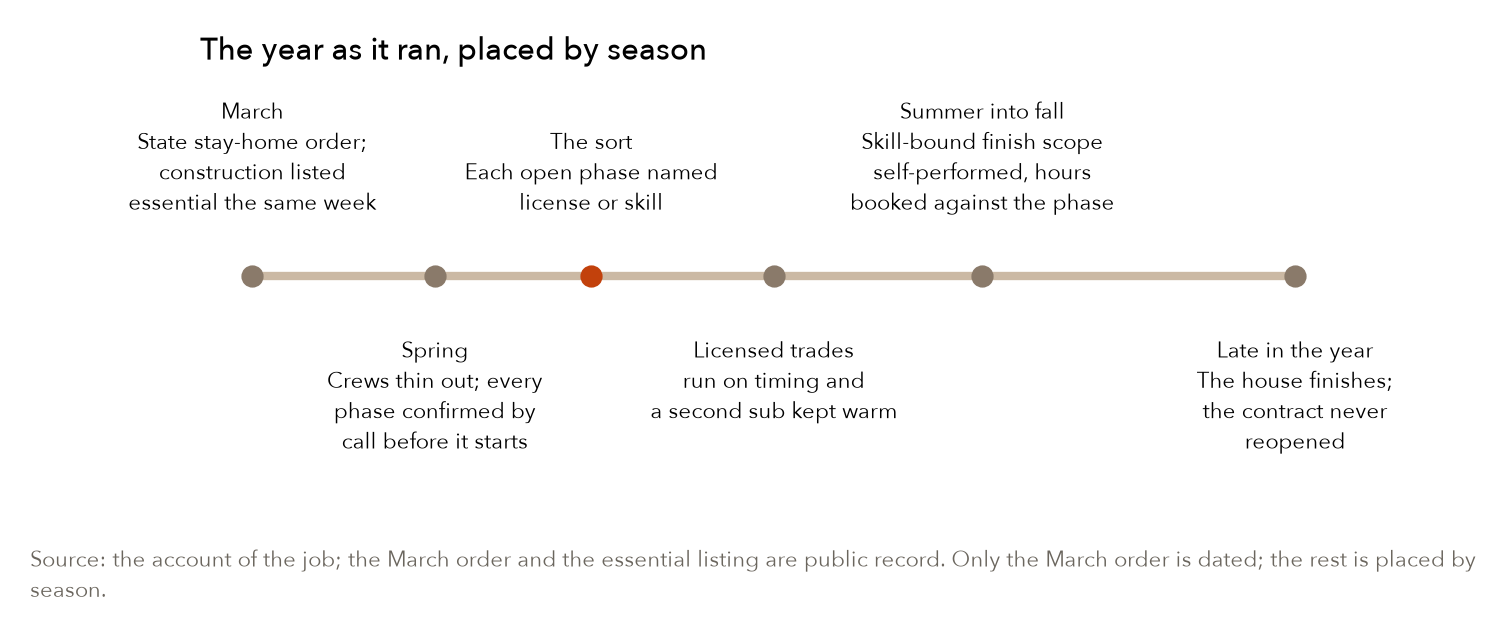
A finished house, delivered to an owner who was never asked to renegotiate a date or a dollar during a year when many owners were being asked for both. The strip below is the year as it ran. The state's order is public record; everything after it is placed by season from the job rather than dated, and the figure says so.
The sort itself is the second product, and the one a reader can use. Each row is a slice of the open scope, what it actually needed, and the lever that fit.
| Open scope | What it needed | Lever used |
|---|---|---|
| Structural framing | A licensed crew, its equipment, its inspection | Timing and buffer: run as early as a confirmed crew allows |
| Rough mechanical, electrical, plumbing | Licensed trade crews | Redundancy: a second sub kept warm on each trade |
| Framing carpentry and finish carpentry | Skill; one experienced person at a slower pace | Direct substitution when the crew thinned |
| Trim, hardware, fixtures, punch | Skill; largely one person's work anyway | Direct substitution as the default fallback |
| Coordination, inspections, owner communication | Time, not a crew | Consolidated under one person |
Two honest readings sit under that table. On the licensed rows the sort confirmed what the trade sequence already said, and the levers there are ordinary scheduling discipline, not a discovery. On the skill rows the comparison was never solo work against a full crew, which solo work loses. It was solo work against no crew at all, which solo work wins, because the alternative had no end date. Both levers ran at once, and the house needed both.
What I kept, what I replaced, what I installed
I kept the trade sequence for every licensed phase, the subcontractors I had worked with for years, and the owner's contract as signed. I replaced the standing subcontractor schedule as the source of truth and the split of coordination across a superintendent and the office. I installed the sort and the rule that direct hours are booked against the phase they replace.
The process that had to change was the schedule itself, and it was not a mistake. The trade-ordered schedule is the industry's default and it was mine on every Tellus job. It sequences work by trade because that is how the work physically stacks, and it treats a sub's confirmed date as a fact because in a normal year that assumption is almost always true. The faulty piece was never the sequence. It was the buried assumption that crew availability is a constant, which no schedule states and every schedule relies on. In the spring of 2020 crews were deciding week to week, and a plan that read availability off a January calendar was going to be wrong every Monday.
The rule the sort runs on
Name the scarce input on every open phase. A license gets timing and a second sub. A skill gets a pair of hands that week, booked against the phase. The owner gets no renegotiation.
What it cost to hold the line, and what I would watch
It cost months of the chief executive's hours on one house instead of on the pipeline, and it put the schedule and quality risk of the finish scope on one person instead of a crew. It cost a bet that the disruption would end before my capacity did; if it had run longer, the cost would have landed on me, not the owner, because I had closed the door on reopening the schedule. Holding an owner's commitment through a year when many contractors were reopening theirs is the kind of thing a client remembers for the rest of the relationship, and I would make the same trade again.
What I would watch, on any job where a crew goes quiet:
- Where the line sits. The sort only works if the license-or-skill call is honest. The temptation is to move licensed work across the line because you are capable; the inspector does not care what you are capable of.
- The call-down. Confirm every crew by name before every phase, and read the sub's tone as data.
- The second sub, before you need it. A backup relationship on each licensed trade is cheap to keep warm and impossible to build in the week it is needed.
- The hours. Self-performed work that is not booked against its phase looks free and is not; the margin walks out of the building unseen.
- When the fix becomes a habit. A chief executive on site with a tool belt is a signal that the system failed, not a system. It bought this house its finish. Still, that year reminded me why a builder never lets the trade skill go. It is the one lever always in the room.
A slice of the project list
A few related projects.
- Greensburg, Kansas: a green disaster rebuild funded by category-exclusive sponsors (2007 to 2008)
- Habitat for Humanity: material, bid work, labor and consulting donated to nonprofit housing chapters (2007 to 2016)
- Soft-story retrofits: a financed seismic compliance service line at Tellus (2017)